
SEND
SEND at The Raleigh School
Our vision is to ensure that all children and young people with Special Educational Needs and Disabilities (SEND) are given the right support, at the right time, to achieve their fullest potential.
We aim to create an inclusive, nurturing environment where every pupil feels valued, supported, and empowered to thrive academically, socially, and emotionally.
Central to our approach is fostering a strong sense of belonging, promoting an understanding of each pupil’s needs, and ensuring effective communication across our whole school community.
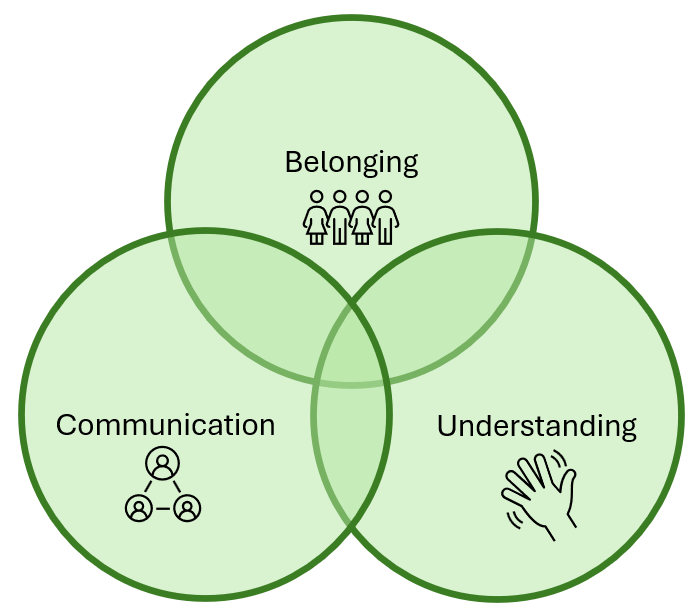
At The Raleigh we are committed to:
• Identifying needs early, ensuring a clear understanding of each child as an individual, and responding with targeted, evidence-based support.
• Working in partnership with pupils, families, and external professionals through open, honest, and proactive communication to provide a holistic, personalised approach.
• Removing barriers to learning so that pupils with SEND experience belonging and can access a broad, balanced, and ambitious curriculum.
• Fostering independence, resilience, confidence and belonging, preparing pupils for positive outcomes in the next stages of their education and life.
Our SENDCo and contact for Looked After Children is Mrs K Garcia who can be contacted through the school office.
Ordinarily Available Provision
What is Ordinarily Available Provision (OAP)?
You can find Surrey’s Ordinarily Available Provision document here: Ordinarily available provision schools' guide
What support you can expect at The Raleigh without an EHCP
All schools in Surrey are expected to provide a range of support for pupils with additional needs as part of day-to-day teaching.
At The Raleigh, this includes:
High-Quality, Inclusive Teaching
- Adaptive teaching tailored to individual learning needs
- Visual supports, scaffolding, modelling, and structured routines
- Clear expectations and consistent behaviour strategies
- Differentiated activities to ensure access for all learners
Classroom-Based Support
- Small group or 1:1 support for specific learning needs
- Check-in systems to support wellbeing
- Access to sensory circuits, movement opportunities or quiet spaces
Targeted Interventions
These may include (but are not limited to):
- Phonics interventions
- Speech, language and communication support
- Lego Therapy to support social skills
- ELSA sessions
- Fine/gross motor skill development
- Attention Bucket
- Lexia
- Power of 2
Working With Specialists
Where needed, we work with external professionals such as:
- STIPS (Specialist Teachers for Inclusive practice)
- Speech and Language Therapists
- Educational Psychologists
- Occupational Therapists
- Mindworks Surrey
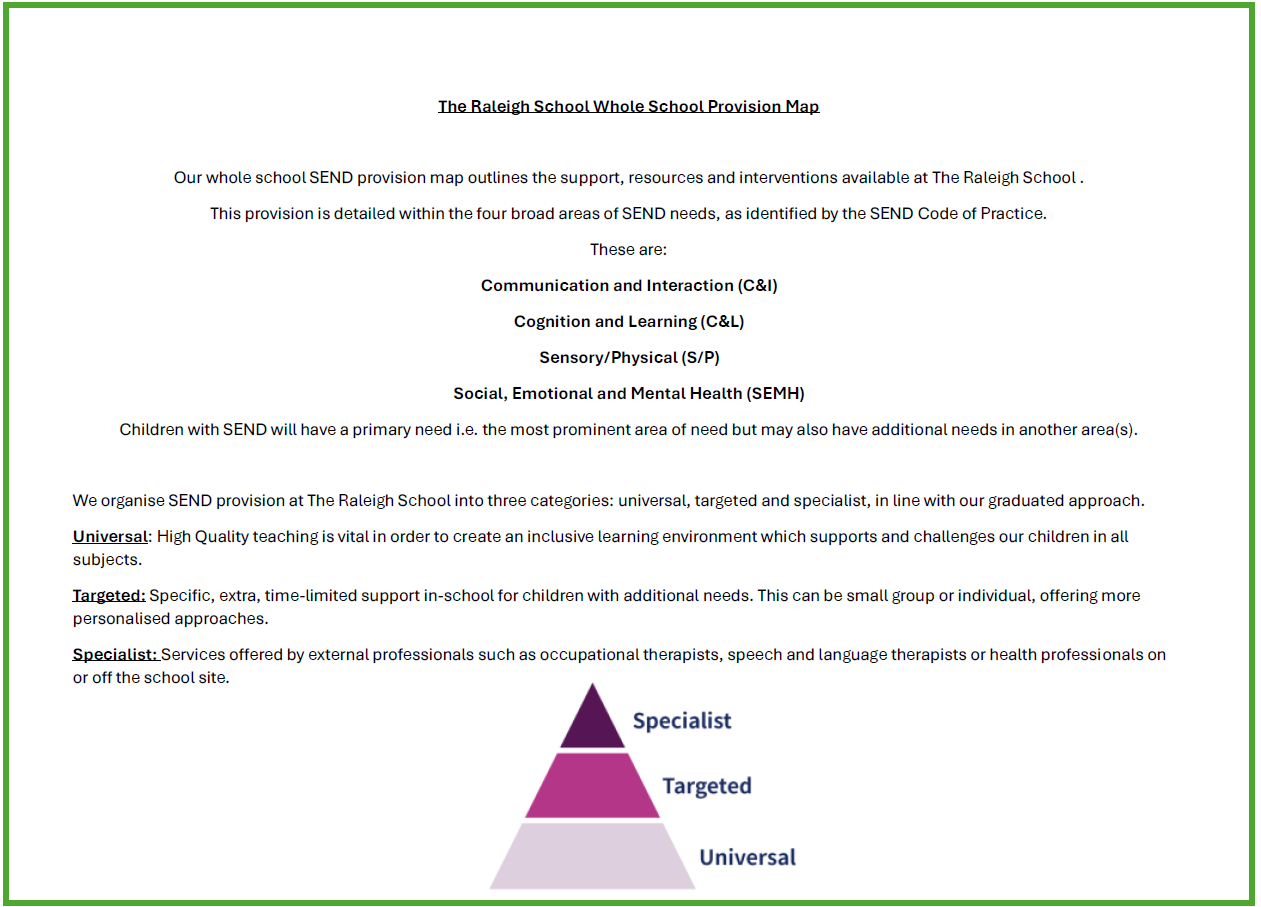
The Raleigh School Graduated Response
The Graduated Approach refers to the system of SEN support within mainstream settings. It is the system by which schools should assess the needs of children and young people and then provide appropriate support.
The system should follow four stages, often referred to as a ‘cycle’: Assess, Plan, Do, Review.
This cycle should not be considered a single process. It provides a continuous cycle of assessment as children’s strengths and needs develop and change.
The four-stage approach is as follows:
- Assess: The class teacher or subject teacher (working with the SENCO) is responsible for carrying out a clear analysis of a pupil’s needs, drawing on teacher assessments and experience of the pupil.
- Plan: Where it is decided to provide a pupil with SEN Support, the parents must be notified. All teachers and support staff who work with a pupil should be made aware of their needs, the outcomes sought, the support provided and any teaching strategies that are required.
- Do: The planned interventions should then be put into place. The class or subject teacher should work closely with any teaching assistants or specialist staff involved and the SENCO should support the class or subject teacher.
- Review: Reviews should take place and inform feed back into the analysis of the child’s needs. The Code of Practice suggests schools should meet with parents three times a year. Good practice would indicate that such reviews will be at least termly. The decision to involve specialists can be taken at any time and should always involve parents
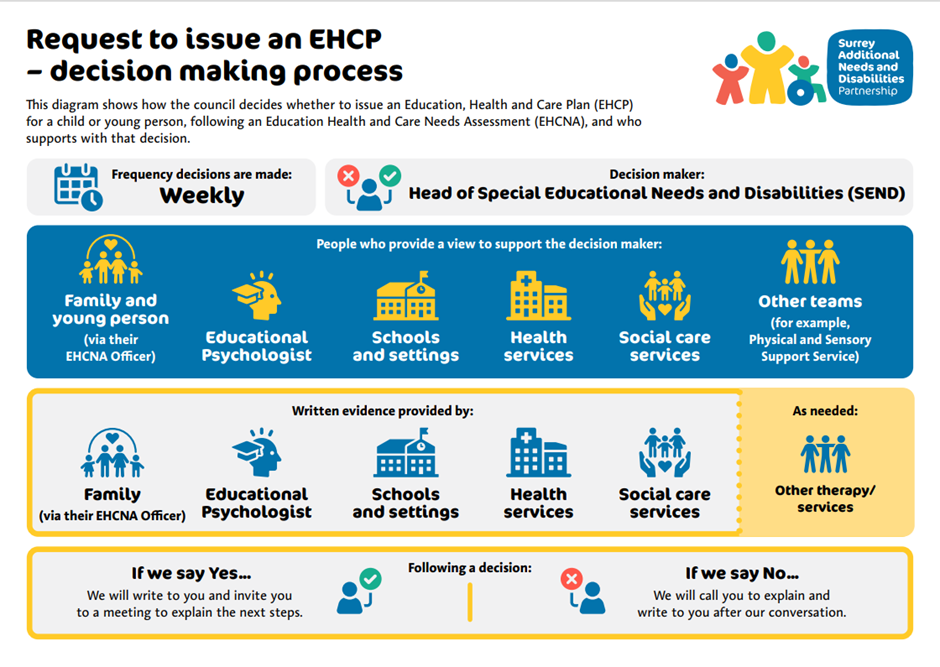
If, despite support being provided in this way, a child or young person is not making expected progress, and requires more support than the notional SEND budgets within the school, then an EHCP may be required.
The school and parents or young person are able to make the request for an EHC needs assessment.

Surrey Advice & Support

About SEND Advice Surrey | SEND Advice Surrey
We work in partnership with Surrey County Council to ensure families can easily access help, guidance and support. The following services are available to parents and carers:
Surrey SEND Advice (formerly SSENS / SENDIASS)
An impartial, confidential service offering support with:
- Understanding SEND processes
- Preparing for meetings
- Navigating EHCP applications
- Understanding rights and responsibilities
Local Offer
Surrey’s online directory of services available for children and young people with SEND, including:
- Specialist services
- Activities and clubs
- Educational support
- Health and therapy services
- Short breaks and family support
Additional Local Support
We signpost families to:
- Parent support groups
- Emotional wellbeing services
- Local charities and advocacy organisations
- Early help and family resilience services
EHCP Process for Parents
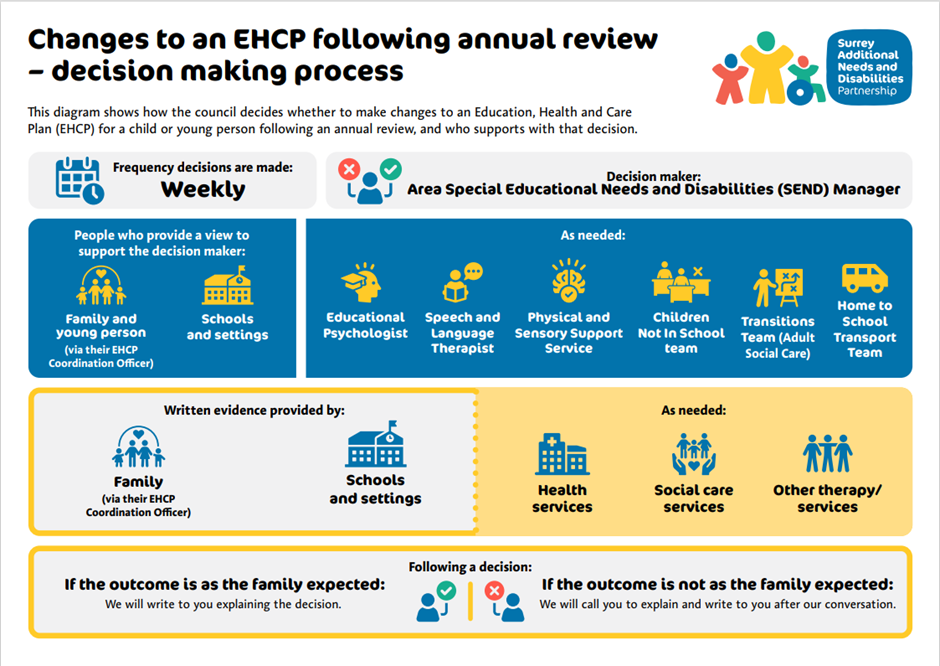
Education, Health and Care (EHC) plans are for children and young people with special educational needs and/ or disabilities (SEND), who need more support than mainstream early years settings, schools and colleges can normally provide.
An EHC plan is a legal document that describes the child or young person's special educational, health and social care needs, and describes what support they will be given to meet those needs.
Before an Education Health and Care (EHC) plan is issued, the local authority, Surrey County Council (SCC) will carry out an EHC needs assessment. This is to find out what support a child or young person needs, and whether they require an EHC plan to get the right level of support.
Most children and young people with special educational needs and/or disabilities do not need an EHC plan. Their needs can be met by support in mainstream early years settings, schools and colleges.
SEND Policy 2024
SEND Information
Whole School Provision at The Raleigh
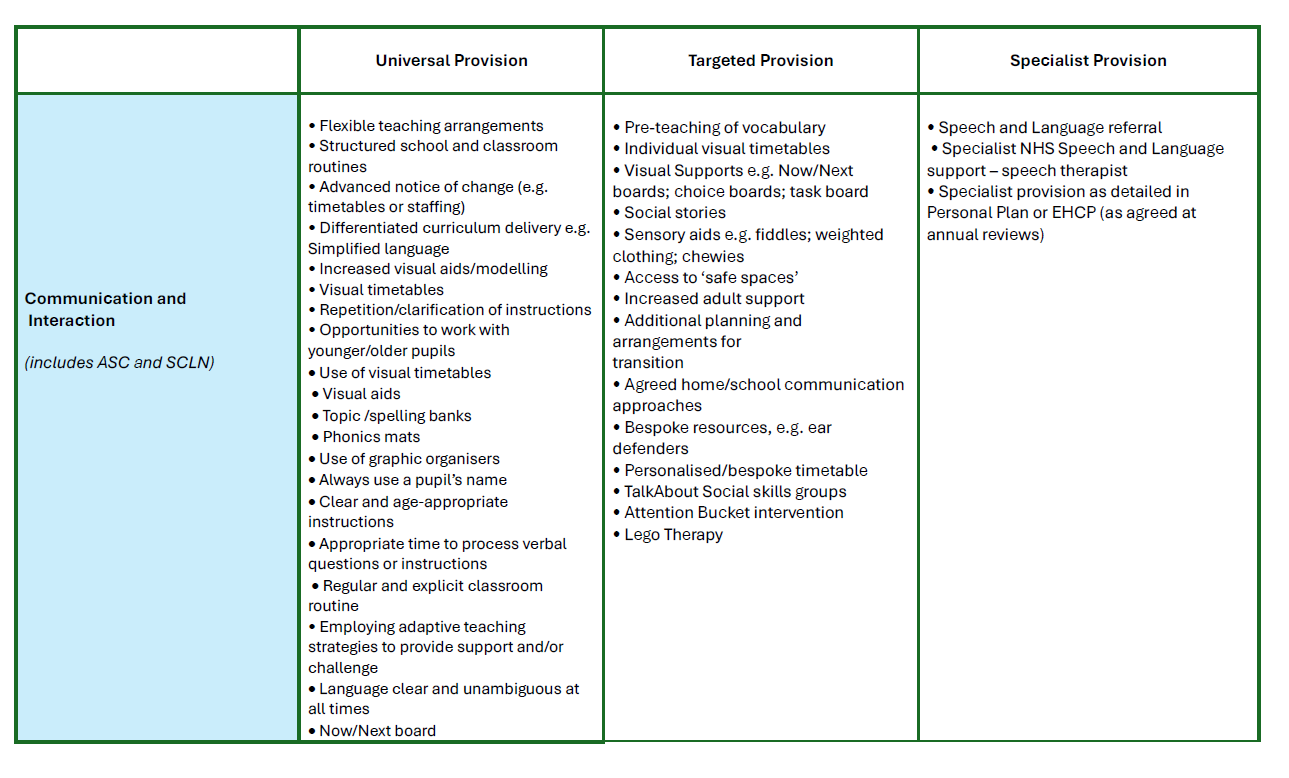
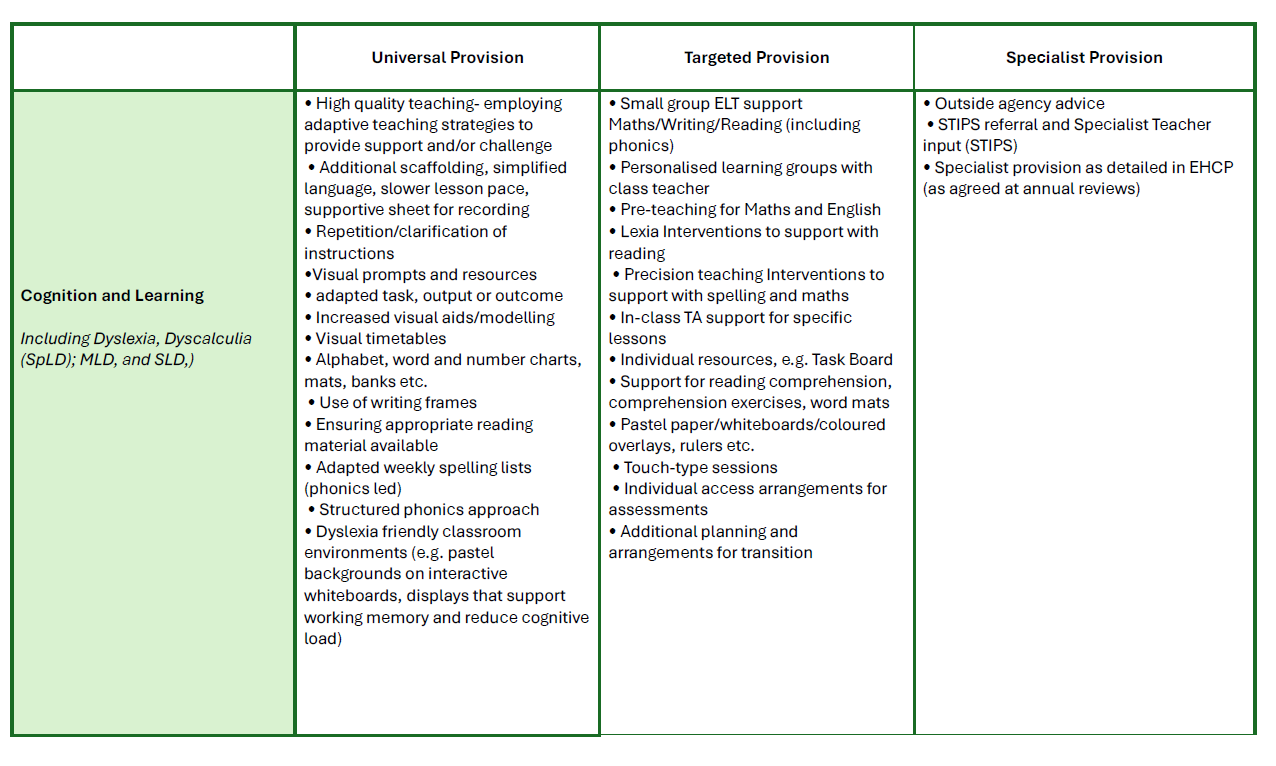
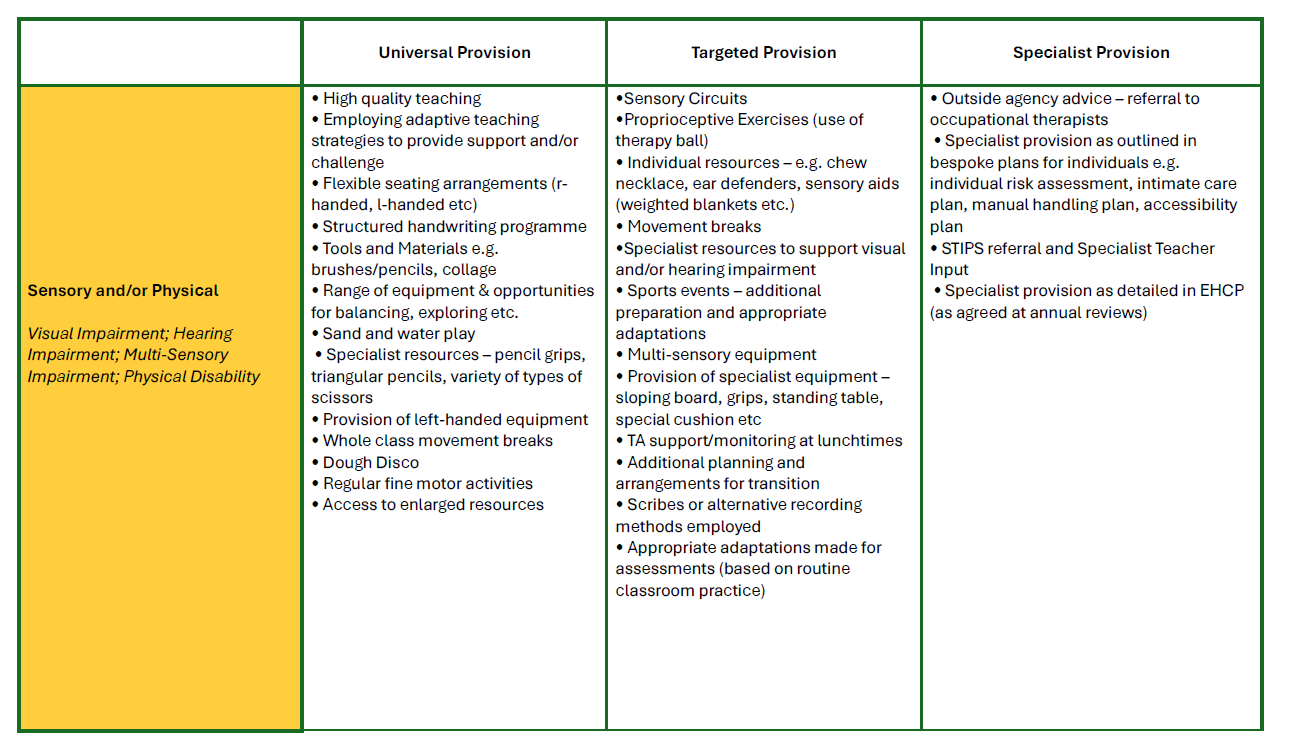
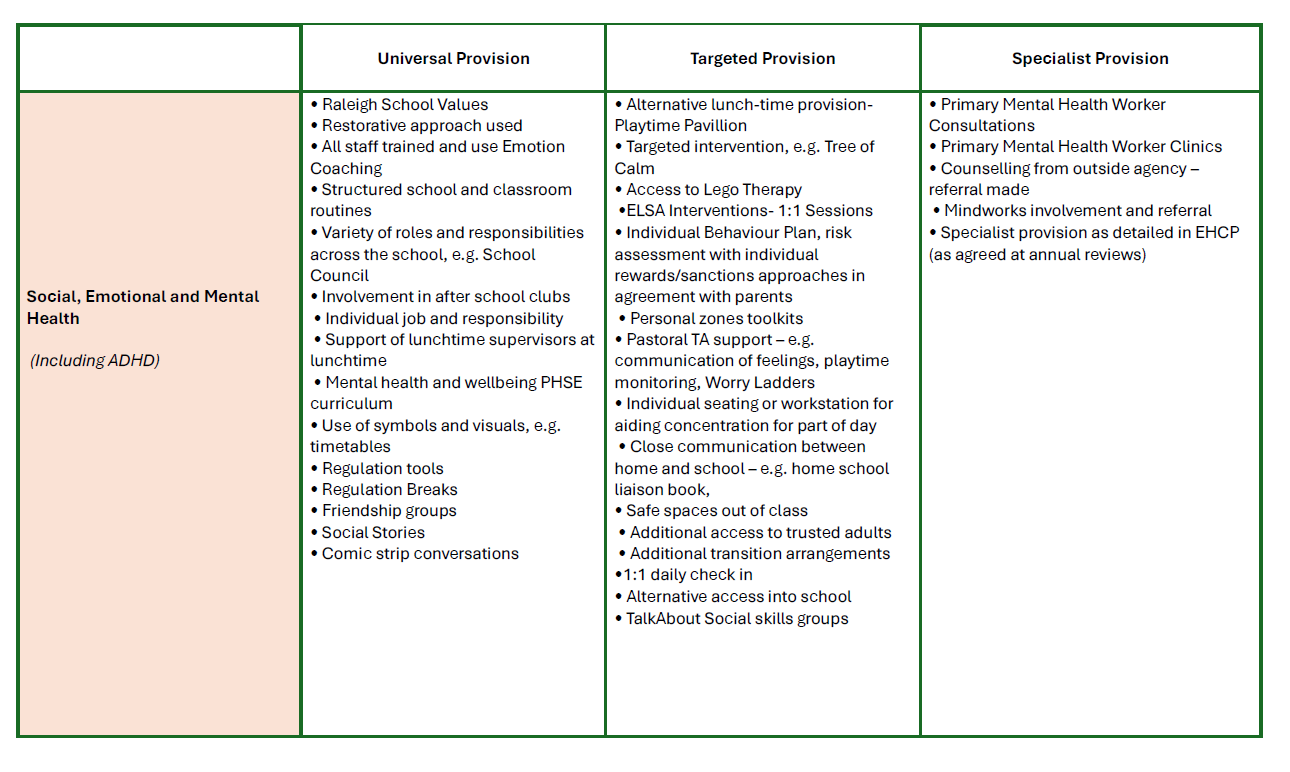
Report (SIR)
The SEND Information Report 2025 is available under Policies. The 2026 report will be published here in due course.